

Need this handled for your company? Talk to Bilancia’s team directly — call +91-9510144494 or email general@bilanciaconsulting.co.in.
For Indian listed companies, ESG reporting has crossed a line. It used to be a narrative exercise, a CSR story told well in the back of an annual report. It is now a mandatory, audit-trailable disclosure regime, and the part driving that change is BRSR Core. If your company is one of India’s larger listed entities, BRSR Core is not a future concern. It is a current operational requirement, and the verification it demands is exactly the part most companies underestimate.
This guide explains what BRSR Core is, how it differs from BRSR, what the assurance requirement really means, and how value chain reporting extends your responsibility beyond your own factory gates. The aim is to make a genuinely technical SEBI requirement clear enough to act on.
What is BRSR?
BRSR stands for Business Responsibility and Sustainability Reporting, the disclosure framework introduced by SEBI for listed companies. It replaced the older, lighter business responsibility report with something far more structured and measurable.
A BRSR is built in three parts. Section A covers general disclosures: the company’s business profile and operational footprint. Section B covers management and process disclosures, aligned to the nine principles of the National Guidelines on Responsible Business Conduct. Section C covers principle-wise performance, combining mandatory “essential” indicators with optional “leadership” indicators. The point of the structure is simple: it forces a company to disclose not just its policies, but its measurable performance against them.
What is BRSR Core, and how is it different?
BRSR Core is a tighter, sharper subset of the full BRSR. Where BRSR is broad, BRSR Core narrows attention to a defined set of high-materiality, investor-facing key performance indicators, and adds the requirement most companies find genuinely demanding: those Core metrics must be verified through third-party assurance.
That word, assurance, is the real difference. A normal BRSR is a disclosure. BRSR Core is a disclosure that an independent assurance provider has checked and stands behind. It changes the standard of evidence completely. A number that was “good enough to report” is no longer good enough; it has to be good enough to survive an assurance review. The Core KPIs span the three pillars:
Environment: greenhouse gas emissions across Scopes 1 to 3, emission intensity measures, energy mix and consumption, water use and discharge, and waste and circularity indicators.
Social: worker safety outcomes such as lost time injury frequency rate and fatalities, employee wellbeing, gender diversity, and inclusive development indicators.
Governance: board and ethics controls, grievance mechanisms, fair engagement with suppliers and customers, and transparency practices.
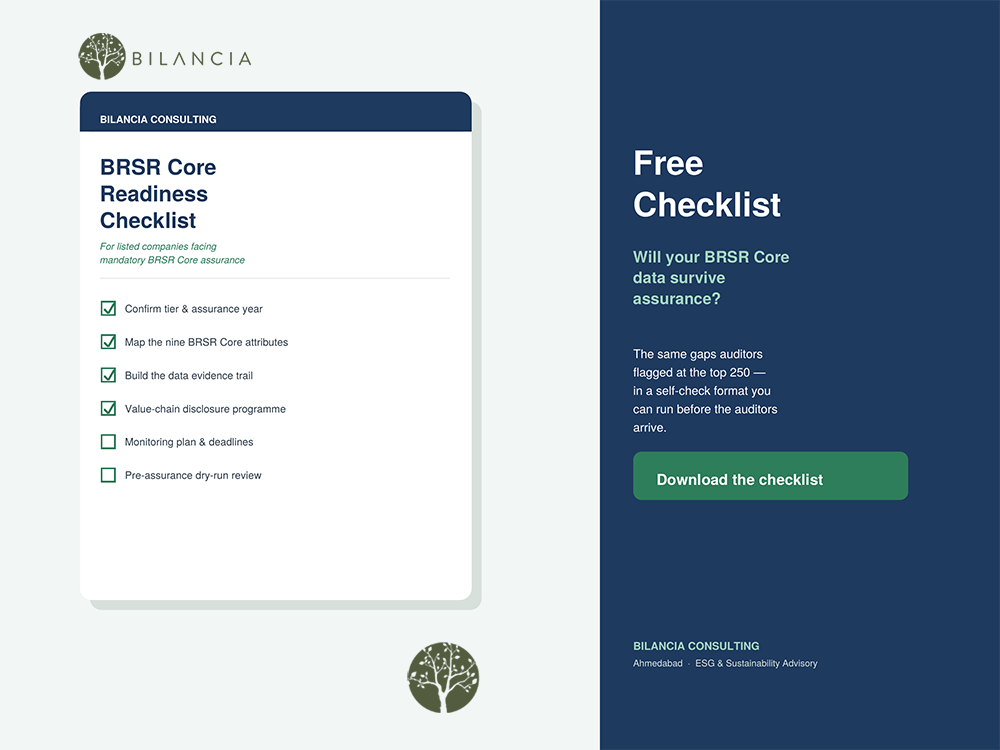
Not sure if your BRSR Core data will survive assurance? Download our BRSR Core Readiness Checklist — the same gaps auditors flagged at the top 250, in a self-check format.
Email me the checklist
BRSR vs BRSR Core at a glance
| BRSR | BRSR Core | |
| Scope | Broad: full ESG disclosure | Narrow: high-materiality KPIs only |
| Verification | Disclosure only | Third-party assurance required |
| Audience | General stakeholders | Investor-facing |
| Evidence standard | Reportable | Assurance-ready, audit-trailable |
The assurance requirement is being scaled in phases
SEBI has not switched on BRSR Core assurance for every company at once. It is being introduced in phases, with the coverage expanding year by year to take in progressively more of the largest listed entities. The practical implication is the part to focus on: for an affected company, assurance-readiness is a near-term operational requirement, not a future ambition to plan for later.
SEBI rolled the assurance requirement out on a fixed market-cap glide path: the top 150 listed entities were covered from FY 2023-24, the top 250 from FY 2024-25, and the top 500 from FY 2025-26. The top 1,000 join from FY 2026-27. Rankings are fixed each year by market capitalisation as of 31 March, so a company sitting near a cohort boundary should track its ranking ahead of time rather than finding out after the fact. Crossing into the assurance perimeter for the first time typically needs six to twelve months of preparation, which is exactly why treating it as a current, not future, requirement matters.
Value chain reporting: the boundary moves outward
The other significant shift is accountability beyond your own operations. Value chain reporting asks companies to disclose ESG performance for their significant suppliers and customers, the partners that matter most, typically identified using materiality thresholds based on a share of purchases or sales. This is where BRSR Core stops being a single team’s job. Collecting and validating data from across a value chain pulls procurement, finance, ESG and legal into the same exercise, and it needs an audit trail that holds together across all of them.
It is worth noting how closely this connects to double materiality: both push a company to look beyond its own boundary and account for what happens across the chain it sits in. A company building one capability is well placed for the other.
What companies should do now
The most useful way to think about BRSR Core is to treat it like financial reporting, because that is effectively what the assurance requirement turns it into. In practice that means:
- Assign clear owners for each Core KPI, the way financial line items have owners.
- Lock the methodologies: how each metric is defined, calculated and bounded, documented and consistent.
- Build the evidence behind every number, traceable back to source records.
- Run internal controls and checks before assurance, not during it.
- Start supplier and value-chain engagement early, because that data is the slowest to collect.
The companies that struggle are the ones that treat BRSR Core as a reporting deadline rather than a data discipline. The ones that handle it well start months ahead, and treat the assurance review as a check on a system that already works, rather than a scramble to assemble one.
What this looks like in practice
The hardest parts of BRSR Core, in our experience, are data organisation and the value chain. On the data side, our ESG Data Book work for a diversified industrial group was about exactly this: centralising sustainability performance data into something consistent and reliable enough to actually report from, which is the foundation assurance depends on. On the value-chain side, our supply chain sustainability assessment work with a multinational manufacturer involved assessing ESG performance across a wide supplier base, the same exercise BRSR value chain reporting now asks of more companies. Neither is quick, which is exactly why starting early matters.
Work with people who do this every week
Bilancia Consulting is an Ahmedabad-based sustainability and ESG advisory firm. We help Indian companies with BRSR Core, carbon market compliance, LCA, and CBAM readiness. If any of this applies to you, a short call is the fastest way to know where you stand.
Book a 20-minute call: +91-9510144494 | Email: general@bilanciaconsulting.co.in
Frequently asked questions
What is BRSR Core?
BRSR Core is a focused subset of SEBI’s Business Responsibility and Sustainability Reporting framework. It covers a defined set of high-materiality, investor-facing KPIs that must be verified through third-party assurance, rather than simply disclosed.
How is BRSR Core different from BRSR?
BRSR is the broad disclosure framework. BRSR Core is a narrower set of high-materiality KPIs within it, and crucially those Core metrics require independent third-party assurance, which BRSR as a whole does not.
Is BRSR Core assurance mandatory?
Yes, for companies within scope. SEBI is introducing the assurance requirement in phases, with coverage expanding to progressively more of the largest listed companies. Affected companies should treat assurance-readiness as a current requirement.
What is value chain reporting under BRSR?
Value chain reporting extends ESG disclosure to a company’s significant suppliers and customers, usually identified by materiality thresholds. It requires collecting and validating ESG data from across the value chain, with an audit trail.
Getting BRSR Core right with Bilancia
BRSR Core rewards companies that treat it as a data discipline rather than a reporting deadline, and that is where the work is. Bilancia Consulting supports Indian listed companies across the full requirement: organising ESG data so it is assurance-ready, getting GHG accounting and the Core KPIs onto solid methodologies, and building the sustainability reporting and disclosure and ESG and compliance foundations that hold up to third-party assurance. If you want BRSR Core handled as a system rather than a scramble, get in touch with our team.