
We carry out full life cycle assessments to ISO 14040 and ISO 14044 for manufacturers who need real numbers on what their products do to the environment. Every study is modelled in SimaPro. For a single product, you’ll usually have the final report 3 to 4 weeks after we receive your data.
We’ve carried out LCAs for manufacturers in the electrical equipment sector, including Polycab.
Call +91-9510144494 or email general@bilanciaconsulting.co.in to talk through your product.
Why companies come to us for an LCA
It’s rarely curiosity. Usually something has changed.
A customer has asked for it
Export buyers and multinational customers increasingly ask suppliers about the environmental impact of specific products. A company-wide carbon footprint doesn’t answer that question. A product LCA does.
You report under BRSR
Principle 2 includes a leadership indicator asking whether you’ve conducted life cycle assessments for any of your products. It’s voluntary, but it’s one of the questions investors and rating agencies notice when it’s left blank.
You want to know where the impact sits
An LCA shows which materials, process steps and energy uses drive the result, so you know where to act first. Those hotspots are often where cost sits too.
You're choosing between materials or designs
Comparing options on the same basis stops you fixing one problem by creating another, like cutting carbon but raising toxicity.
What a full ISO 14040/14044 LCA includes
A full LCA looks at more than carbon. We follow the four stages set out in ISO 14040 and ISO 14044:
- Goal and scope. We agree with you what the study is for, the functional unit (for example, one tonne of product or one unit sold), the system boundary, and which impact categories matter for your product.
- Life cycle inventory. We collect your data, check it for gaps and errors, and fill the gaps with recognised background data.
- Impact assessment. We model the product in SimaPro and calculate results for the categories agreed at scope, such as climate change (your product’s carbon footprint), human toxicity, ecotoxicity and resource depletion.
- Interpretation. We identify the hotspots, explain the trade-offs, and give you recommendations you can act on. We also translate the results into real-world comparisons, so people outside the sustainability team can see what the numbers mean.
You get a final report that sets out the method, data, assumptions and results in line with ISO 14044.
We agree the system boundary with you at the scoping stage. Our guide to cradle-to-gate assessment explains the common options.
How it works and how long it takes
- Scoping call. We learn about the product, why you need the LCA, and agree the scope.
- Data handover. You share the data listed here. We go through it with you and flag anything missing.
- Modelling and analysis. We build the model in SimaPro and work through the results.
- Report. You receive the final report with findings and recommendations.
For one product, this takes 3 to 4 weeks from the point we have your data. If you need several products assessed, we’ll give you a timeline when we agree the scope.
What we’ll need from you
The quality of an LCA depends on the quality of the data. Here’s what we’ll ask for:
- Complete manufacturing process details. Every step from raw material receipt to finished product, with the inputs and outputs at each stage.
- Bill of materials. What goes into the product, and how much of each.
- Energy data. Electricity, fuel and any other energy used in production, ideally by process or line.
- Waste management data. What waste the process creates, how much, and where it goes.
If some of it isn’t available, tell us at the start. We’ll work out with you what can be measured, what can be estimated, and how that affects the result. It’s much better to know this before the study begins than after.
FREE DOWNLOAD
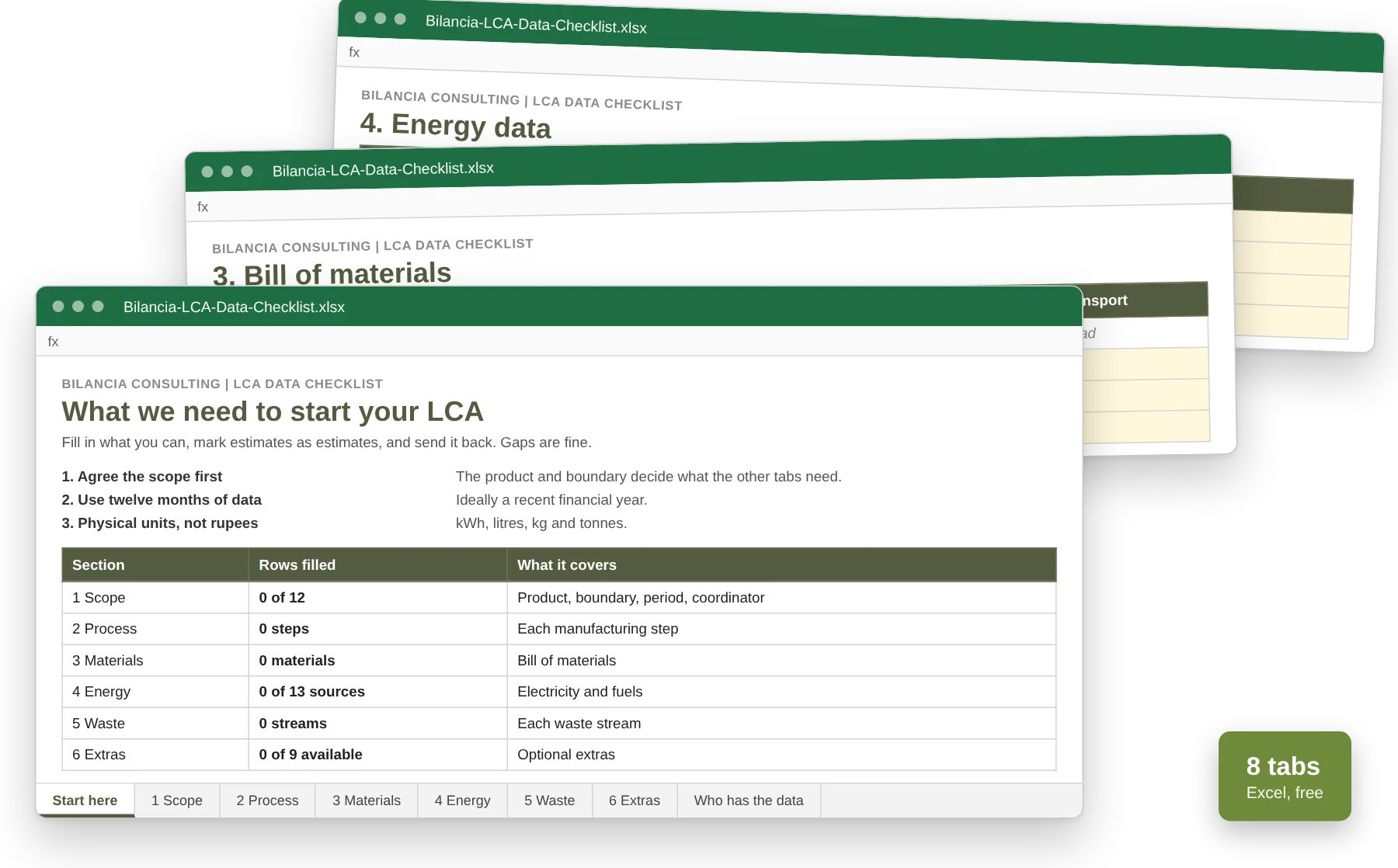
The LCA data checklist
The Excel file we give clients before an LCA starts. Hand it to your plant team and they’ll know exactly what to pull together.
- Tabs for scope, process steps, bill of materials, energy, waste and useful extras
- An example row on every tab, so nobody has to guess the format
- A tracker that shows how complete your data is
- A list of who in your company usually holds each item
Fill in what you have and send it back. We’ll tell you what’s missing before the study begins.
Get the checklist
Who does the work
Bilancia has been advising Indian industry on sustainability since 2009. Our LCA work is supported by an advisory board that includes experts from the Gujarat Pollution Control Board, the Institute of Resource Analysis and Policy, and Gujarat University.
We work with clients across India, the United Kingdom and the UAE.

LCA and circular design
An LCA often points straight at circular economy opportunities: a material that could include recycled content, a waste stream that could go back into the process, or a design that simply uses less.
We help you turn those findings into practical changes, from circular product design to waste valorisation.
Questions we get asked
What is a life cycle assessment?
How long does an LCA take?
What data do I need to provide for an LCA?
Which LCA software do you use?
What's the difference between an LCA and a product carbon footprint?
Can an LCA help reduce operating costs?
Which industries do you carry out LCAs for?
Is an LCA required under BRSR?
Further reading
- Life cycle assessment in India: the complete guide
- Cradle-to-gate in life cycle assessment
- How to calculate your company’s carbon footprint
- CBAM default values: what Indian exporters pay without their own data
Bilancia Consulting is an Ahmedabad based sustainability and ESG advisory firm. Alongside life cycle assessment, we help companies with GHG accounting and sustainability reporting and BRSR disclosure. If a customer has asked for product data, or you want to know where your product’s impact really sits, a short call is the quickest way to scope it.
Call +91-9510144494 or email general@bilanciaconsulting.co.in