

Need this handled for your company? Talk to Bilancia’s team directly — call +91-9510144494 or email general@bilanciaconsulting.co.in.
If your company has been notified as an obligated entity under India’s carbon market, registration is not optional. Until you complete carbon credit registration on the Indian Carbon Market (ICM) portal, you cannot submit compliance documents or manage your Carbon Credit Certificates. This guide explains who must register, what to prepare, how the registration process works, what documents are required afterwards, and what happens if you miss a deadline.
What is the Indian Carbon Market?
The Indian Carbon Market operates under the Carbon Credit Trading Scheme (CCTS). The scheme is administered by the Bureau of Energy Efficiency (BEE). The ICM Registry, where registration and certificate management happen, is operated by Grid Controller of India (Grid-India). Trading itself is regulated by the Central Electricity Regulatory Commission (CERC).
In simple terms: BEE runs the scheme, Grid-India runs the registry you register on, and CERC oversees the trading. For an obligated entity, the registry is the system you interact with most, because registration, compliance submissions and certificate transactions all flow through it.
Who must register for carbon credit registration in India?
Registration is mandatory for all notified obligated entities covered under the Greenhouse Gas Emission Intensity (GEI targets) set under the scheme. If your facility has been notified, you are required to register and comply. Entities that are not notified are not obligated to register, though some may choose to participate in the market on a voluntary basis.
If you are unsure whether your facility has been notified, that is the first thing to confirm, because every deadline that follows depends on it.
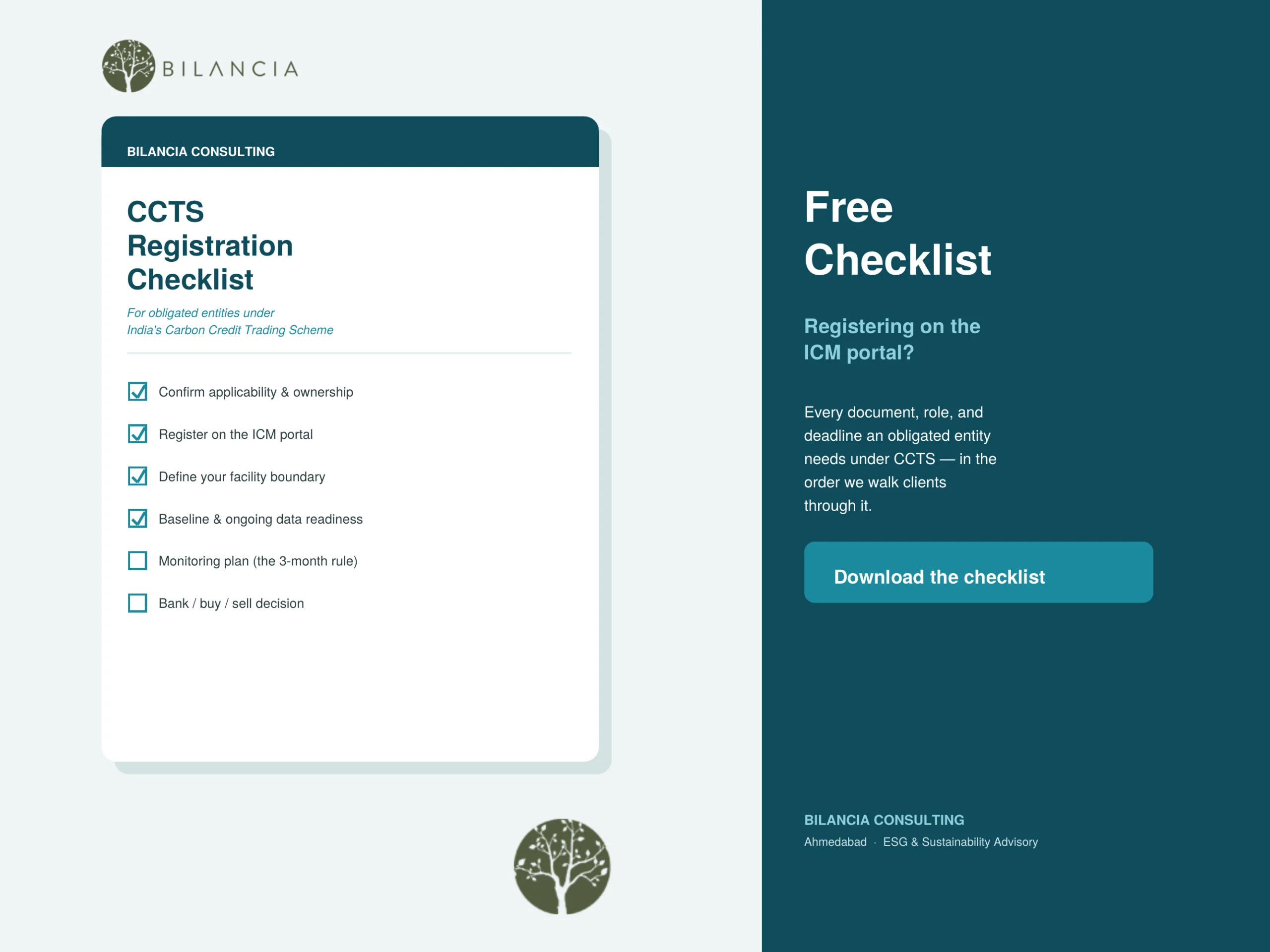
Registering on the ICM portal? Download our CCTS Registration Checklist — every document, role, and deadline an obligated entity needs, in order.
Email me the checklist
What to prepare before you register
Registration goes far more smoothly when the groundwork is done first. Before starting, an obligated entity should have three things in order.
Authority and roles. Decide who will act in each capacity: an authorised signatory, a compliance owner, and a technical data owner. These roles carry real responsibility, so they should sit with people who can commit the organisation and who understand the facility’s data.
Facility boundary. Define clearly what is inside and outside the facility boundary. This includes the list of emission sources and the metering or sampling points used to measure them. A vague boundary is one of the most common causes of problems later in the compliance cycle.
Baseline and ongoing data readiness. Gather production data, fuel and electricity consumption, the calculation workbook, and the evidence trail behind every number. Verifiers will expect data that can be traced back to source records, so this preparation directly affects how smoothly verification goes.
How the registration process works, step by step
- Confirm your obligated status. Verify that your facility appears on the notified list of obligated entities under the scheme.
- Appoint your roles. Formally assign the authorised signatory, compliance owner and technical data owner before you begin, as the portal will ask for these.
- Create the entity account on the ICM Registry. Register the obligated entity on the registry operated by Grid-India and provide the requested organisational details.
- Submit identity and authorisation documents. Provide the supporting documentation that establishes the entity and the authority of its signatory.
- Define and submit the facility boundary. Enter the facility details, emission sources and metering points that make up the registered boundary.
- Complete verification of the account. Once details are reviewed and approved, the account becomes active and can be used for compliance submissions and certificate management.
Once registration is complete, the entity can move into the compliance documentation cycle described below.
What compliance documentation is required after registration
Registration is the entry point. The ongoing obligation is the compliance documentation, and there are two main pieces.
The Monitoring Plan. A monitoring plan must be submitted within three months of the start of the first trajectory period, and then annually, within three months of the start of each compliance year. It sets out how the facility’s data will be monitored and is an early requirement, so it should not be left until the last moment.
The annual submission. After each compliance year, the entity must submit a duly verified Performance Assessment Document (Form A) and a Certificate of Verification (Form B). These are due within four months after the end of the compliance year. Both must be verified, so the verification process needs to be scheduled well before the deadline.
What happens if you do not comply
Once the first Carbon Credit Certificates start changing hands (see how carbon credit trading will work in India), non-compliance carries a real financial penalty. An obligated entity that fails to meet its obligations can face environmental compensation equal to double the average traded price of Carbon Credit Certificates. This compensation is payable within 90 days. Beyond the direct cost, missed deadlines create regulatory exposure and disruption, which is why most obligated entities treat the compliance calendar as a fixed commitment rather than a flexible one.
Work with people who do this every week
Bilancia Consulting is an Ahmedabad-based sustainability and ESG advisory firm. We help Indian companies with BRSR Core, carbon market compliance, LCA, and CBAM readiness. If any of this applies to you, a short call is the fastest way to know where you stand.
Book a call: +91-9510144494 | Email: general@bilanciaconsulting.co.in
Frequently asked questions
Is carbon credit registration mandatory in India?
For notified obligated entities, yes. Registration on the ICM Registry is required before an entity can submit compliance documents or manage Carbon Credit Certificates. Entities that have not been notified are not obligated to register.
Who operates the registry for carbon credit registration?
The ICM Registry is operated by Grid Controller of India (Grid-India). The wider scheme is administered by the Bureau of Energy Efficiency, and trading is regulated by the Central Electricity Regulatory Commission.
What documents are required after registration?
The two main ongoing documents are the Monitoring Plan and the annual submission of the verified Performance Assessment Document (Form A) and Certificate of Verification (Form B).
What is the penalty for non-compliance?
Environmental compensation equal to double the average traded price of Carbon Credit Certificates, payable within 90 days.
How Bilancia Consulting can help
Carbon credit registration and the compliance cycle that follows involve detailed data, strict deadlines and verification that has to hold up to scrutiny. Bilancia Consulting supports obligated entities across the full process:
- Registration and facility onboarding, including defining roles, setting the facility boundary and managing the evidence trail.
- Monitoring plan and MRV controls, covering data flow, meters, sampling, quality assurance and the audit trail.
- Annual compliance and verification coordination, including Form A and Form B-ready documentation and closing out any non-conformities.
If your facility has been notified as an obligated entity and you want support getting registration and compliance right, get in touch with our team. You may also find our guide on whether to buy or reduce carbon credits useful when planning your compliance strategy.